(photo courtesy of mia)
HYDE PARK AND WOODHOUSE ONLINE
what's happening in our area

(photo courtesy of mia)

The Law School has an annual intake of 250 undergraduates. In addition it has 150 postgraduates, 40 research students and 65 permanent staff. This means the new building will bring 1,005 new people and their cars into this quiet residential area. And yet amazingly, the proposal will result in ten fewer on site car parking spaces than at present.
Traffic will increase on Belle View Road due to the new car park entrance being relocated to Belle Vue Road. And the new entrance will also mean less street parking for residents. In addition, all the site’s rubbish will be collected from Belle Vue Road rather than from within the site. It’s very wrong that Leeds University and Leeds City Council expect local residents to bear the cost of this development in terms of increased traffic, parking congestion and obstruction.
As with almost every other development that will negatively impact this area, there were no objections to this application from our local councillors. It was left to Councillors Elizabeth Nash, Ted Hanley and Ruth Feldman to speak against it, and they were outvoted.

Reference

“It may seem like a low-level crime to some but it ruins how an area looks and makes people feel unsafe. It is criminal damage on large scale, costing council taxpayers thousands of pounds to put right”
He’s not talking about barbeques on Woodhouse Moor which ruin the look of a huge part of our area and last year cost over £100,000 in fire engine call-outs. He’s talking about graffiti.
Local residents who are sick and tired of being unable to use their local park because of police inaction over anti social behaviour, have taken Inspector Jessup to task over his and his colleagues’ double standards. In a published reply to the inspector, Tony Green advises him that a few exemplary arrests would solve the anti social behaviour problem overnight. And Helen Graham asks the inspector how he can stand by and do nothing when there are people breaking the byelaws by barbecuing and leaving a horrible mess all over the park.
It’s time our local police realised that their behaviour on this issue is bringing their name into disrepute. Parking on double yellow lines doesn’t help either.


It would be good if this additional evidence persuaded the council to abandon the consultation exercise. But experience suggests that this is unlikely.
Statistician Paul Marchant has kindly agreed to let me publish an email he sent to the council explaining to them that the likelihood of receiving no survey forms from 299 streets is less than 13 in a billion. Paul addressed the email to Councillor Ryk Downes as Councillor Downes is the Scrutiny Board councillor who dismissed earlier statistical evidence indicating that the council’s consultation exercise is flawed. Paul sent a copy of the email to the INWAC councillors and the leaders of the three parties.
Dear Ryk,
I was told shortly after my original emailing that the number of streets I used was wrong and re-did the calculation based on the 454 valid streets. The results are basically the same in suggesting that getting responses from only 155 streets is improbable.
You seem to have some misunderstandings:
One does not need to assume that all streets have the same number of residents. My calculation assumes that the streets which did not respond only contained one house, to maximise the probability of non-response which is taken to be 1- 587/9982 i.e. 1- 5.9%. = 0.9412. The probability of none of the 299 streets generating even one response is, using the rule for independent probabilities, 0.9412 times itself 299 times or 13 parts in a billion….a very small number. (I chose the assumption of one house streets to maximise this probability, as any other choice will give an even smaller number.) Therefore I judge that there is a prima facie case suggesting that the exercise is flawed. Indeed I understand that several concerned local citizens say they did not receive the forms …. Why not believe them rather than the organisation doing the survey? As I said in my email, “What evidence can be given that the survey was carried out properly in the light of this improbable result?”
Your assertion that streets with 17 houses would ‘guarantee’ a response is not quite correct. It would not guarantee it …the average response equals one but is of course subject to probability and getting zero would be quite common…about 1/3.
Politicians seem to bandy statistics with an unwarranted air of confidence. You say “I believe ALL members of scrutiny were satisfied that enough data had been obtained.”…If your belief is correct, this is worrying…
It is true when you say that a sample of 1000 will estimate a proportion of a large population; say the proportion in favour of one of the major parties within a ‘margin of error’ of a few percent. It relies on equal selection probabilities. (A cook does not need to taste the whole of a pan of soup in order to know what the soup is like, sip will do. So it is with sampling, but it must be a fair sample!) In the BBQ survey it seems the selection probabilities are in fact unknown and it appears indeed that there is ‘something funny going on’ from the result above.
The ‘What is a Survey’ guide (elementary material) available at the American Statistical Association’s web site http://www.amstat.org/sections/srms/
See http://www.whatisasurvey.info/ . (I recommend it in my work at Leeds Metropolitan University). It outlines problems in surveys such as that due to non-response. The book ‘Survey Research Methods’ by Floyd Fowler is fairly light and good.
I would encourage the council to engage proper professional statistical advice for statistical issues. The danger is that otherwise the ‘information’ obtained is likely to be bunkum.
Yours sincerely,
Paul Marchant
The announcement last year that the Lib Dem leadership was planning to drop the party’s pledge to scrap tuition fees will have set alarm bells ringing for Lib Dem MPs in constituencies with large numbers of students like Leeds North West. That’s because such MPs believe they hold their seats due to the student vote. An article about this was published in the Guardian prior to the 2005 General Election (1). It states:
Liberal Democrat research has identified 14 seats where there are enough students to take them from second place to beat Labour, and 13 where they could go from second to beat the Tories. It is based on all students voting in their university rather than home constituencies.
The article identifies Leeds North West as being one of 14 Labour seats that the Lib Dems were hoping to win thanks to the student vote. And as predicted, Liberal Democrat Greg Mulholland was duly elected as the MP for Leeds North West in the 2005 General Election.
Now that the Lib Dems nationally are no longer promising to scrap tuition fees, perhaps their “Campaign Group for Student Constituencies” will be able to find new ways to persuade students to vote for them. This is a group set up by Mr Mulholland earlier this year with the message that the Liberal Democrat party “best represents university constituencies and the interests of students, academics and long-term residents alike” (2).
Perhaps as a prelude to this campaign, Mr Mulholland had a meeting with Leeds University student rep Rob Damiao where, according to Mr Damiao, a relationship was established which it’s hoped will result in more students voting at the next election. Since the Lib Dems claim to have far more student supporters at Leeds University than the other parties, they’ll no doubt be hoping that the majority of these extra voters will be voting Lib Dem (3).
References
Students can swing 27 seats say NUS – April 2005
Lib Dems form campaign group for student constituencies – March 2009
Student rep’s work update report – January 2009

Our Lib Dem councillors are trying to alter polling district boundaries and polling stations to enable more students to vote on or close to the university campus. If successful, their proposals would effectively disenfranchise many permanent residents. The first alteration would involve transferring voters from part of polling district HWD to polling district HWF. The Lib Dems give the following reason for the change,
“Most of the residents being moved into HWF are students at St Mark’s flats and student residents on Clarendon Road so would best be served by a polling station at the university.”
But what of the retired people who live in the Harrison Potter Home on Raglan Road. At present they can vote simply by walking down the road to Woodhouse Community Centre but under the Lib Dem proposal they’ll be required to go to the university campus to vote. The students who live in St Mark’s flats and Samara Plaza can presently quite easily vote at Woodhouse Community Centre, but it would not be so easy for permanent residents to visit the university.
The second Lib Dem proposal would require all the voters in polling district HWF north of Woodhouse Lane to vote at the new Marjorie and Arnold Ziff Building inside the university campus, instead of as at present, in the Parkinson Building. Apparently, the university has said that it will no longer allow the Parkinson Building to be used as a polling station, and the Marjorie and Arnold Ziff Building is the alternative being proposed by the Lib Dems, presumably with the agreement of the university. If this change goes ahead, it will deter many permanent residents from voting as most local people do not know their way round the university campus. If the Parkinson Building is no longer available for use as a polling station, then an alternative should be provided outside the university campus. Local residents should not be required to enter the university campus in order to vote.
The third Lib Dem proposal affects a polling district boundary not shown on the above map. If it goes ahead, it would mean that two student tower blocks would be transferred from polling district HWH to polling district HWG. The Lib Dems give the following reason for the proposal,
“Two new large student blocks, Concept Place and The Triangle are a lot further from the polling station in HWH than they are from the polling station in HWG at the Swarthmore Centre on Woodhouse Square”
This is actually not the case. The Triangle is equidistant between the two polling stations and Concept Place is only very slightly closer to the Swarthmore Centre. This proposal has been designed like the other two, with the interests of students in mind as the Swarthmore Centre is very close to the university. However, unlike the other two proposals, it appears to have no negative consequences for permanent residents.
Where you vote is supposed to be based on where you live. But for a very large number of students, our Lib Dem councillors are trying to make it more about where you study. And they’re doing this at the expense of permanent residents.
Reference
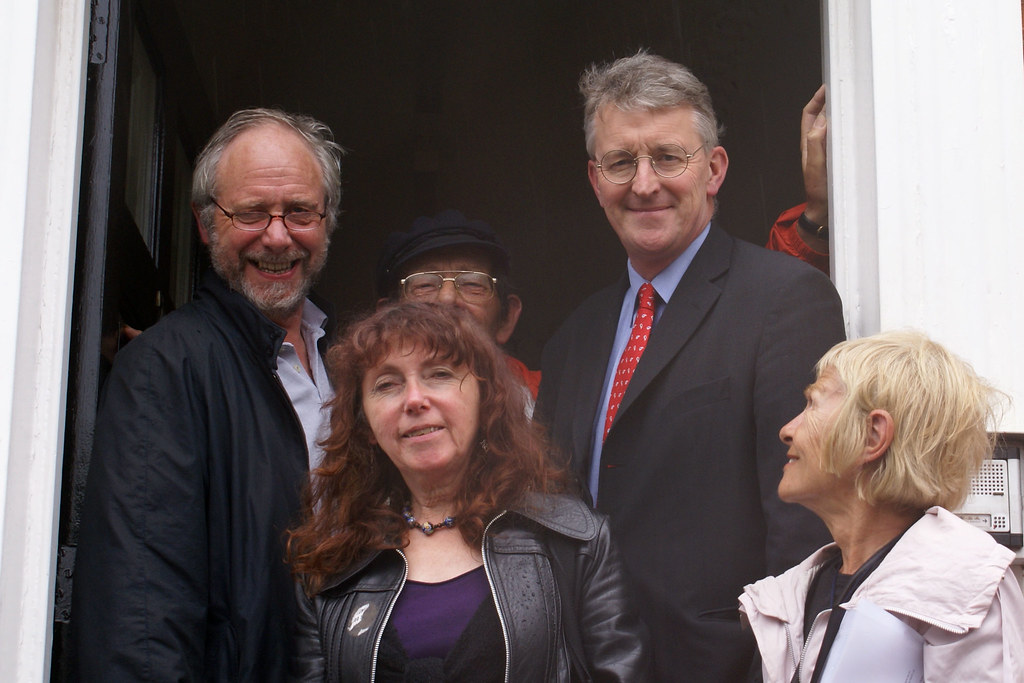
 Representatives from local community groups met earlier today with Leeds Central Member of Parliament Hilary Benn to update him on Leeds City Council’s barbeque proposal and consultation exercise. The last time we met Mr Benn was on the 1st May and there was much to tell him about that had happened since then, such as the revelation that the barbeque proposal had come from three multi agency meetings held last year from which local community groups had been excluded; that the minutes of these meetings showed that in May, June, and July last year, the fire brigade had been called out to Woodhouse Moor 52 times at a cost estimated to be in excess of £100,000; that statistical evidence based on Parks and Countryside’s own figures supports residents’ claims that the vast majority of them had failed to receive survey forms, and that Leeds City Council’s Scrutiny board has ignored this evidence and the testimony of residents and given the consultation exercise the rubber stamp of its approval.
Mr Benn re-iterated his opposition to the barbeque proposal saying ” I think that it’s a very bad idea and I hope that the council won’t go ahead with it” and promised to do all he can to help the community in its efforts to get the scheme scrapped and the byelaws upheld. To this end, he gave us his permission to publish a letter he sent more than two months ago to Leeds City Council’s Chief Executive setting out his reasons for opposing the scheme, and saying that enforcement of the existing barbeque ban is the best option.