The road widening threat to Woodhouse Moor is back, and it’s called NGT

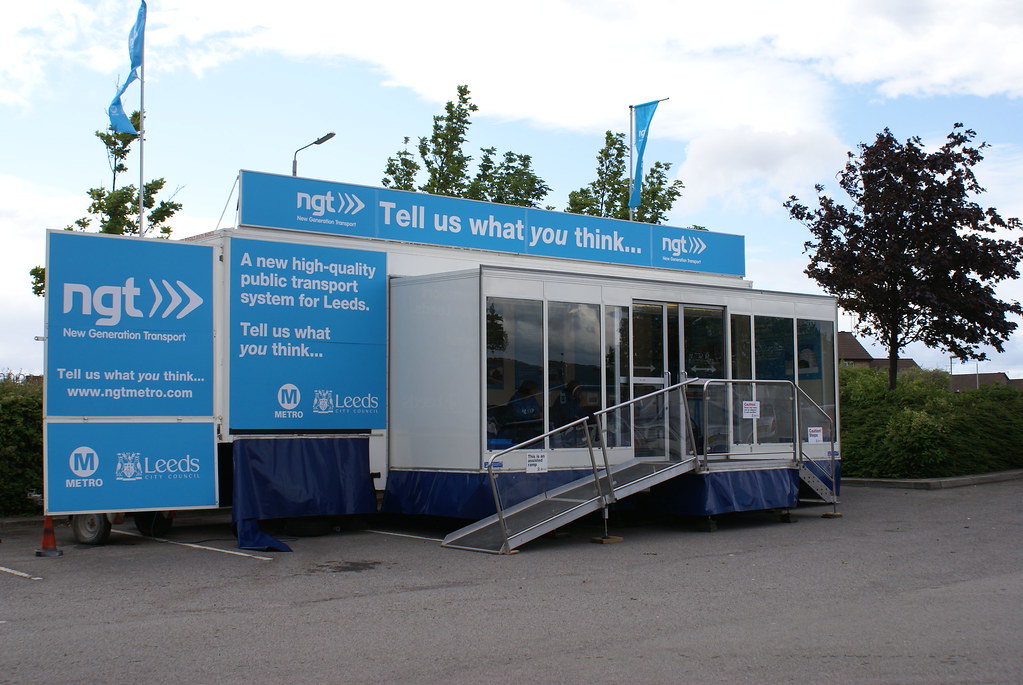
NGT trailerLast Thursday, the 18th June, Leeds City Council and Metro unveiled their plans for New Generation Transport (NGT), a scheme that would see trolleybuses running in leeds for the first time since 1928.  The plan is to have three routes; the East Route, the South Route, and the North Route, with the trolleybuses running along dedicated bus lanes wherever possible

The North Route would run along the line of the A660.  Because there’s no plan to knock down any of the buildings opposite the university, this would create a bottleneck at the junction of the A660 and Clarendon Road. To cope with this bottleneck, traffic would be stacked on Woodhouse Moor.  This would be done either by widening the existing road between Rampart Road and Clarendon Road, or by building a new road across Monument moor.  The second option exists because the Highways Department are aware of local sensitivity about losing the avenue of trees.

The stated aim of the scheme is to create an improved public transport system using dedicated bus lanes wherever possible. But if that’s the aim, then it could be achieved by creating dedicated bus lanes within the existing highway.

This scheme would affect Woodhouse Moor in an almost identical manner to the scheme proposed by Highways at the end of last year. At that time, we were told that the road widening was necessary to facilitate a pedestrian crossing on Clarendon Road.

A new website has been set up to keep people informed about this latest threat to our area – New Generation Transport

A Critique of the Report of the Director of City Development to the Scrutiny Board, 9th June 2009

This report gives cause for grave concern. Not only is it tellingly sub-literate in its writing (I take it that Officers who cannot distinguish illicit from elicit are likely to be illicit in their dealings, because they know no better) but it begs questions from start to finish.


Executive Summary #3 : ‘The Council has received complaints from 20 households…’

Does this mean that 20 households formally complained? In writing for example?

Were the reports from local activists, sent to Nicole Jackson, taken into account?

Was the show of hands at a public meeting with Councillors present taken into account, which, if representative, would suggest that significantly more than 50% of local residents had not received the questionnaire?

How were some fraction of 10,000 households supposed to complain, when they didn’t know they had anything to complain about?

Are we really to believe that 9,999 or, at worst, as few as 9,990 were delivered?

Even on a good day, that wouldn’t happen. It’s reminiscent of Romania under Ceausescu, when he always got 99% of the popular vote. Do Council Officers think we’re fools?


Background Information #2.3: The opposition has been expressed very clearly… alongside support for the proposition from other members of the public.’ Who precisely? In the extensive correspondence in the YEP engendered by this issue, precisely one correspondent has supported the proposition, and he is known to be a Lib.Dem. activist, and prospective candidate for the HP&W ward. If Council Officers know of other ‘support’, would they tell us what it is?


#2.4: ‘…what is traditionally looked on as a popular activity… Tradition is a very important notion. That it should be appropriated to justify the destruction of public property makes us feel sick. Perhaps the writer of this document might be asked to define ‘traditionally’ and ‘popular’? (But actually this is just sloppy thinking, and another manifestation of Liberalism Lite. What the citizens of Leeds need is a bit of intelligence from their Councillors and Officers.)


#2.5: Things cannot be more or less ‘aesthetic’, any more than they can be more or less unique. Could we have an account by the writer of what is meant (preferably using the English language)?


#2.6 activity is conducted in the allocated area…: ‘…enforcement emphasis changes from trying to stop barbecues to requesting the activity is conducted in the allocated area…’ ‘Requesting’ is very nice. Presumably local Councillors and Senior Officers of Parks & Countryside will stroll around doing the ‘requesting’? We wish. Even if they did, we wish them luck. We’ve tried a bit of ‘requesting’ ourselves, as ordinary citizens: the response wasn’t very pleasant.


‘The concept and design…has been extensively discussed with the Woodhouse Moor Multi-Agency Forum. From which local community-groups were excluded. Why?


Main Issues #3.1: Leave aside obvious solecisms re. which we’ve made our point (Freudian slip possibly?): ‘The consultation exercise was not designed as a formal referendum’. Yes it was. It was Yes or No (and see below.) Sure, there was room for comment, but the paper declared roundly that there was no room for adjustment or compromise. Incidentally, no deadline was given, which surely invalidates it immediately?


‘The consultation commenced on 20 March and it is anticipated that responses from all stakeholders will be received by the end of June.’ So why, though only as a result of challenge, were residents informed of a deadline of the last week of April?


#3.4: ‘The questionnaire…asked respondents whether they wanted a designated barbecue area or not.’ See above, #3.1., ‘…not designed as a formal referendum.’ Can somebody explain the contradiction?


#3.6: This whole paragraph is so astonishing, even by the standards of LCC, that we scarcely know where to begin. Let’s not pick through it – though we can and will if you really want – let’s just say that LCC asked DBS if it had done the job. DBS said it had, surprise surprise, and that’s good enough for LCC. So, DBS tells the truth, and local residents are liars? We’d have to be terribly well organised liars to lie so consistently, wouldn’t we? Whereas wouldn’t you agree that a company needs only one person to lie on its behalf?


Implications for Council Policy etc #4.1: ‘The consultation exercise is an important prerequisite…’ Since the consultation exercise is known to be flawed (no deadline published, manifest opportunities for multiple voting, the factual certainty of incomplete delivery etc) then ‘a designated barbecue area on Woodhouse Moor’ cannot be established, I assume? Unless of course ‘planning permission be [not] required’, in which case why are we all wasting our time?


Legal and Resource Implications #5.3: ‘The costs [sic] of the consultation exercise was £2,467…’ At a public meeting, Cllr Ewens estimated it at £10,000; none of the Councillors present questioned the figure. Do we take it that she and they were all wrong by several miles? Do we take it that our Councillors are clueless? Or do we take it that the authors of this paper are misrepresenting the budget?


#5.5: This becomes repetitive. See above. But since we are down to single cases: the non-delivery to our own address owed nothing to ‘access difficulties’.


We have here 22 begged questions in a 4pp document. A triumph of incompetence by any standards. We expect an answer to all 22 before the next meeting of the Scrutiny Board. We are citizens and voters and it is our right.


We are pleased to know that the Scrutiny Board referred this report for further consideration. We trust that our comments may assist the Board in its further deliberations.


Reference

Report of the Director of Development, 9th June 2009

Fudge

Fudge

Over a year ago, Council and Leeds University staff held a series of closed-door meetings to discuss anti-social behaviour on Woodhouse Moor. Councillors Jamie Matthews and Penny Ewens were at those meetings; but although reps from the Students’ Union were present, no other community groups were represented.


It was then that the scheme for a barbecue area was conceived. In December, the Leeds University Community Rep., who knew that there was to be a series of consultation meetings three months before anybody else, was drawing up letters for students to sign and give to the Council. All other sections of the community, from neighbourhood associations to the Mosque, were in the dark.


Then in March 2009, posters went up on the Moor. A large colour photo showed people basking in the Elysian sunshine. “Do you want to barbecue on Woohouse Moor (Hyde Park)?” the poster asked, without explaining that answering “Yes” to that question would approve sinking forty huge concrete blocks into the oldest public park in Leeds.


This was the first that anybody except the Students’ Union, Council Officers, and University employees had heard of the plan. Two drop-in sessions were scheduled: one of them was in the Leeds University Students’ Union.


The form made available at these drop-ins was starkly simple. Again, the question was put, “Do you want a designated barbecue area on Woodhouse Moor Park?” You could answer “Yes” or “No”. Ongoing debate was terminated. You didn’t have to put your name and address on the forms – so people could fill in as many as they liked. The consultation had no deadline.


And 10,000 of these forms were, apparently, mailed out to all houses within an 800m perimeter of the Moor. Vast swathes of the catchment area didn’t receive one.


But fear not! The Council yesterday produced a report on the conduct of this dubious farrago. It insists that asking people to vote “Yes” or “No” to a proposal is not a referendum; it’s purpose was rather to “illicit the range and balance of views on this issue” and “gauge…the respective arguments”. They gauged the range of people’s views by asking them: yes or no?


And the delivery company contracted to deliver the forms, Distribution Business Services, are glowingly exonerated. Twenty households made a formal complaint that they had not received a form. In all but one case, DBS was able to confirm delivery. Though How they were able to confirm this, the report does not explain.


One form, alas, couldn’t be delivered due to obstructed access to the property; but this was subsequently rectified. Furthermore, says the report, DBS have ISO9001:2001 accreditation!


The people of Hyde Park and Woodhouse can breathe a sigh of relief. Everybody has received a form. The seventy people at a public meeting who claimed they hadn’t got one were obviously lying.


[ To read the full report, click here.]

Where is the cost-benefit analysis in support of designated barbeque areas ?

In their report to the Executive Board dated the 8th October 2008, Parks and Countryside accept that the use of barbeques on the Moor causes damage to the park and is associated with anti-social behaviour. The report then states that their preferred solution to the problem is to restrict barbecuing to designated areas of the park, so as to contain the problem, rather than to prohibit it.

But the provision of designated areas alone will neither solve the problem, nor contain it. Continual monitoring will be needed to prevent barbeques being lit elsewhere than in the designated areas. At the same time, these areas will need continual maintenance and cleansing to ensure that they remain useable and do not become eyesores.

Since the report’s authors have rejected the request for park wardens on the ground that this would “not be the best use of limited resources available in the budget,” the report should provide evidence in the form of cost-benefit analysis, that the provision of designated areas would be a more effective use of resources than the provision of park wardens.  In the absence of such evidence, the proposal to establish designated barbeque areas should have been rejected by the Executive Board.  Instead, they’ve initiated a costly consultation exercise to gauge support for the proposal, an exercise which is itself flawed, just like the proposal.


References

Report of the Director of Development dated 8 October 2008

When the end justifies the means, truth is the first casualty

In February 2006, Leeds City Council’s Department for Learning and Leisure obtained £170,341 to build a pay and display car park on Woodhouse Moor. They obtained the funds by telling Leeds City Council’s Director of Resources there had been consultation with local community groups. In reality, there had been no consultation.  (1)

Then in November 2008, when the council’s Highways Department wanted to widen the inbound lane of the A660 where it crosses Woodhouse Moor, in order to obtain £135,000 to fund the planning of the project, they told the Director of Resources that there had been consultation with local community groups.  Again, this wasn’t true.  If the project had gone ahead, it would have obliterated the avenue of trees and York stone pavement adjacent to the inbound lane of the A660 between Rampart Road and Clarendon road. (2)

Shortly before this in October 2008, in a report that dismissed local people’s request for park wardens to enforce the byelaws, and instead proposed designated barbeque areas, Parks and Countryside told Leeds City Council’s Executive Board that local community groups including Friends of Woodhouse Moor had been present at multi agency meetings.  The minutes of these meetings held in May,June and July 2008, show that they gave rise to the proposal for designated barbeque areas. They also show that local community groups had not been present.  When challenged about the discrepancy between the report which states that community groups had been present at the meetings, and the minutes, which show that they hadn’t, Parks and Countryside claimed that a meeting attended by Friends of Woodhouse Moor on the 10th May 2007 had also been a multi agency meeting. (3)


References

Design and Cost Report dated 9 January 2006
Design and Cost Report dated 24 November 2008
Report of the Director of Development dated 8 October 2008

The views of the parties responsible for this fiasco

These are the views of the parties who were present at the multi agency meetings that took place in May, June and July last year.


Councillor Penny Ewens (chair)

“Where are people without gardens to have barbeques if not on the Moor?”

Councillor Jamie Matthews

The reports of anti social behaviour have been exaggerated.  If some people had their way, they’d stop everyone having fun”.

Amanda Jackson (Leeds University)

Concern that the media had exaggerated the scale of the problem.

Parkswatch

They say they’ve had instructions not to do anything about barbeques, and that the byelaws have nothing to do with them.

The two student reps

Students not to blame.

Police

About the endless partying on the Moor “It’s wonderful. A real carnival atmosphere.”

And like Parkswatch, the police repeatedly say that the byelaws have nothing to do with them.


With views like these, it’s no wonder that the parties to the multi agency meeting came up with a solution to the problem which by legitimising the existing situation, allows them to continue to shirk their responsiblities.  The only reason we have a problem, is because of the refusal by the police and the council to enforce the byelaws.  What’s happening on the Moor is not some kind of natural disaster outside their control.


References

  1. Councillor Ewens said this at the Civic Hall on the 10th May 2007.
  2. Councillor Matthews said this at an INWAC meeting on the 3rd July 2008.
  3. Amanda Jackson is minuted as having expressed this concern at the multi agency meeting on the 16th May 2008.
  4. This was said to one of the Friends by Parkswatch officers on the Moor on the 29th May 2009 when he asked them why they weren’t doing anything to stop illegal barbeques.
  5. The two student reps expressed this sentiment in letters to the YEP published on the 19th May 2008.
  6. The statement about the “wonderful carnival atmosphere” on the Moor was made by a police sergeant at Kendal Carr on the 19th June 2008.